


An Emmy-Winning Gem You Don't Want to Miss!
Every once in a while, a film arrives quietly on Netflix and completely surprises you. Remarkably Bright Creatures is exactly that kind of unexpected delight—a warm, heartfelt story that feels like a nice Earl Grey tea on a Fall afternoon.
Based on the beloved novel of the same name written by Shelby Van Pelt, the film centers on family, loss, hope, second chances, and the surprising ways our lives intersect. Set against the backdrop of a charming small town, it explores missed connections, hidden truths, and the discoveries that can change everything. While I won't spoil the story's many pleasures, one of its most unique and enchanting features is that part of the narrative comes from an octopus. Yes, an octopus—who is a central character of the movie!
The narration by Alfred Molina is filled with wit, wisdom, and just the right amount of gentle mischief. His performance adds warmth and personality to every scene, offering observations that are often funny, occasionally poignant, and always engaging.
At the center of it all is Sally Field, who delivers a performance that reminds audiences exactly why she remains one of the most beloved actors of her generation. Her portrayal is nuanced, deeply human, and full of quiet strength. Every smile, hesitation, and moment of vulnerability feels authentic. It's easy to see why her work has been receiving such praise and why this movie topped Netflix charts for many weeks.
What makes Remarkably Bright Creatures especially appealing is its optimism. This isn't a story driven by spectacle or grand twists. Instead, it finds beauty in ordinary people, small-town communities, and the idea that it's never too late for healing, friendship, or a fresh start even though the story starts with the reality of loss and regret.
In a season often dominated by darker thrillers and crime dramas, this film is a refreshing reminder that heartfelt storytelling still has the power to captivate. As summer gives way to fall, Remarkably Bright Creatures is a lovely little gem—thoughtful, uplifting, and absolutely worth adding to your must-watch binge list. And by the way, it won Sally Field yet another Emmy!

A Visualization of Anthropic's plea: "We Must Pace the Frontier"


The Surprising Story Inside My Netflix Spreadsheet
A few weeks ago, I did something most people don't realize they can do: I requested my streaming data from Netflix. I expected a spreadsheet but what I got was a personality test disguised as a CSV file.
Turns out, data has a secret superpower: it tells stories. Not the stories on your screen—the story of you.
Buried in thousands of rows of viewing history was a surprisingly clear picture of my streaming personality. According to the numbers, I'm a Story-Driven Explorer.
Not a casual browser. Not a reality-show hopper. More like someone who happily commits to multiple seasons, complicated plots, and fictional characters who make terrible life choices.
The data revealed a few things:
🕵️ Mystery Seeker – I love suspense, investigations, and plot twists.
⚖️ Legal & Political Strategist – Courtrooms, government intrigue, and high-stakes decisions? Apparently that's my comfort food.
📚 Series Loyalist – If a show has six seasons, I see that as a challenge, not a warning.
🌎 Global Story Fan – Great stories don't need passports.
🎬 Quality Over Quantity Viewer – I'd rather finish one excellent series than sample ten mediocre ones.
The funny part? Nobody asked me these questions.
Netflix never handed me a personality quiz.
The data simply watched my choices and connected the dots.
That's the magic of data storytelling. A spreadsheet isn't just numbers. It's patterns. Habits. Preferences. Tiny clues that reveal something bigger.
Schools use data to understand how students learn. Businesses use it to understand customers. Streaming data can reveal whether you're a comedy lover, a documentary addict, or someone who somehow watched four seasons of a legal drama in one weekend.
Every click leaves a breadcrumb. Enough breadcrumbs, and a story emerges.
In my case, the verdict is clear:
The verdict?
My data reveals a person who is endlessly curious about how people think, why they make the choices they do, and what happens next.
The medium just happens to be Netflix.


.png)
The Odyssey: Where Myth, Ambition, and Humanity Collide
There are movies that entertain, movies that impress, and then there are movies that demand something from you. The Odyssey feels like the last category—an audacious undertaking from Christopher Nolan that reaches for one of the oldest stories ever told and insists that it still has something urgent to say. It's intense, relentlessly ambitious, and unafraid of its own scale.
Matt Damon anchors the journey with remarkable credibility, bringing both vulnerability and resolve to a hero who survives as much through wit as endurance. Anne Hathaway delivers grace and emotional weight, while Tom Holland injects the story with energy and the recklessness of youth. Together, they make an ancient epic feel immediate.
The spectacle is overwhelming, but never empty. The Cyclops, the shipwrecks, the monsters, and the mythic grandeur all serve the story rather than distract from it. Every sequence feels grounded in physical reality, giving the adventure a sense of danger that's increasingly rare in blockbuster filmmaking. If those practical achievements are as extensive as they appear, they represent an extraordinary commitment to cinematic craftsmanship.
What lingers most isn't simply the scale—it's the conviction behind it. At a time when we're surrounded by AI-generated images and increasingly uncertain where reality ends and fabrication begins, there's something deeply refreshing about filmmakers striving for tangible performances, real locations, and authentic human collaboration with no CGI. It reminds us why cinema became magical in the first place.
The success of The Odyssey is that has brought to life a timeless epic with a profoundly human touch opening a new chapter where vulnerability, artistry, and human creativity reclaim center stage.

More Than a Trophy: Messi's LEGACY
Spain are worthy world champions. Their victory over Argentina in the FIFA World Cup Final was built on discipline, technical excellence, and composure under the greatest pressure. Football celebrates a new champion, and Spain deserve every accolade.
Yet, as the celebrations unfolded, much of the world's admiration was reserved for the man who walked away without the trophy.
At 39, Lionel Messi once again achieved what few believed possible, leading Argentina to a second consecutive World Cup Final. In a sport where careers at the highest level rarely extend this far, Messi continued to orchestrate attacks, inspire teammates, and captivate millions with the same elegance that has defined his career for two decades.
Perhaps no one has captured that legacy better than Sir Alex Ferguson, who said:"I will say something that some people won't like, but I don't care. We will never see another footballer like Lionel Messi. When he retires, an era of football retires with him. Players will win Ballon d'Ors, score hundreds of goals, and lift trophies, but no one will combine genius, consistency, longevity, and humility in the way he has."
As the final whistle echoed around the stadium, the inevitable question emerged: What comes next? Will Messi step away from international football, or will the love of the game draw him onward for one more chapter? Whatever his decision, it will not alter the verdict of history.
He has conquered football's greatest summit, inspired generations across continents, and redefined what sustained excellence looks like.
Spain have the trophy. Lionel Messi has something even rarer: a legacy that transcends results. Championships define teams, but true greatness defines generations. When Messi finally leaves the game, football itself will be saying farewell to one of its most extraordinary eras.


You know the match nobody is supposed to care about? The one played after your heart has already been broken? Apparently nobody told England and France.
Three days after England spent twenty bewildering minutes watching a World Cup final slip away against Argentina, they showed up for the bronze medal match and collectively decided that defense was an optional extracurricular activity.
The result? England 6, France 4. Ten goals. Ten!
Somewhere in England, a tactical analyst is still staring at a whiteboard asking questions nobody can answer.
The face and question of the evening was Bukayo Saka. Not because he scored a hat trick—though he did—but because he looked like a man determined to prove that football keeps going even after your dreams temporarily stop. Every touch carried purpose. Every run carried a little bit of defiance. But why or why was he not used for the semi-final.
Across the field stood Kylian Mbappé, still chasing the Golden Boot and looking like someone who had misplaced more than a chance at a trophy. There was a heaviness to him. Yet even crestfallen stars remain stars. Mbappé struck twice and spent much of the evening reminding everyone that a wounded lion is still a lion. France roared but England raced ahead.
At 6-4, the score looked less like a football match and more like a hockey match.
When the final whistle arrived, England celebrated, France exhaled, and millions of British fans probably did the same thing when Jude Bellingham made the sixth beautiful British goal. Yet after the game in their moment of triumph, the likes of Harry Kane and Saka could not help but reflect on their troubling loss to Argentina in the semi-final which they are all processing and reflecting upon.
Some tournaments are remembered for champions. This one might also be remembered for the beautiful chaos left behind. Also the unity it brought a torn up world. And with the cue, wa are on to the finals on Sunday Messi vs. Yamal, history will tell.

Ten Goals, Zero Chill

Argentina and the New York Knicks: Magic Meets Passion Meets Victory!
There’s a moment in sports when talent stops being the story.
Not because talent disappears. England had plenty of it. Argentina had plenty of it. The New York Knicks certainly had their share. But every so often, a game becomes about something harder to measure and impossible to ignore: belief.
That’s where the New York Knicks and Argentina’s national team seem to meet.
Neither team has been defined solely by star power. They’ve been defined by collective will. By players willing to dive for loose balls, track back one more time, make one more run, and sacrifice individual glory for something larger than themselves. They play with their hearts on their sleeves, and in modern sports, where analytics can explain almost everything, that remains wonderfully difficult to quantify.
The England–Argentina semifinal felt like one of those contests.
England arrived with Premier League pedigree, world-class talent, and the confidence that comes from competing at the highest levels every week. They were organized, experienced, and dangerous.
Argentina brought all of that too, but they also brought something else.
They brought a nation.
You could see it in every challenge, every recovery run, every moment when tired legs somehow found another gear. And hovering over it all was the figure of Lionel Messi—not merely a captain, but a living symbol of a generation’s dreams. The players weren’t just trying to win a football match. They were trying to write one more chapter for the maestro and one more memory for millions back home.
But it can tilt the field.
The Knicks know this. Argentina knows this.
The teams that endure, the teams that surprise, the teams that keep moving forward are often the ones united by purpose.And purpose, on the biggest stages, can be a very difficult thing to defend.


England versus Argentina this week will be the sort of match that reminds us why football refuses to be reduced to predictions and post-match analysis.
England is like a finely engineered clock tower rising above a modern city skyline. Forged in the furnace of the Premier League, their players have spent years navigating the most demanding football stage on earth. They are polished, disciplined, and formidable—a team that inspires confidence not through spectacle but through reliability.
Argentina sweeps into a tournament the way a thunderstorm rolls into town—beautiful, unpredictable, and impossible to ignore. The team carries talent in abundance, certainly, but also something far more intoxicating: the collective heartbeat of a nation that believes it is witnessing the closing pages of a cherished novel.
At the center of it all stands Lionel Messi.
Not merely a footballer now, but a figure who has somehow slipped beyond sport and into folklore. In every generation there are athletes whose achievements are measured in trophies. Then there are those whose careers become family stories, told across dinner tables and passed from parent to child.
And so Argentina's supporters watch these matches with the intensity of people unwilling to leave the theatre before the final curtain falls. They know every great story must end. They simply aren't convinced this one should end yet.
England, of course, has its own romance. For decades the English have approached major tournaments with equal measures of confidence and caution, yet this squad feels different. Younger, calmer, less burdened by ghosts. They have not marched to this semifinal on nostalgia. They have earned it through performance.
What makes this encounter so irresistible is that both teams represent different visions of football itself. England is the architecture while Argentina is the music.
England is the carefully drafted blueprint while Argentina is the splash of paint across the canvas. One trusts preparation, while the other trusts inspiration.And somewhere between those two forces lies the reason billions of people continue to love this game.
Because occasionally football produces evenings that feel larger than sport. Evenings where history taps gently on the shoulder of the present and asks to be let in.
England seeks another chapter in its long pursuit of glory.
Argentina seeks something even more elusive—a perfect ending.
Whether the night belongs to the architects or the artists remains to be seen.
Great Expectations, One Last Tango
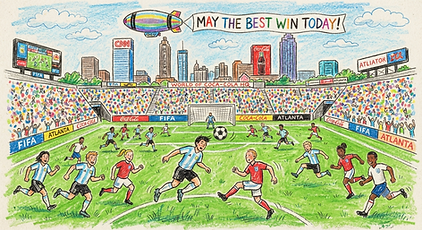

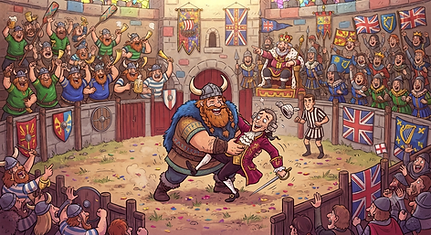
The Final Showdown: Norway vs. England
There are two ways to arrive at a World Cup quarterfinal.
The first is to be England.
You inherit history, expectation, and intense speculation. Every pass is analyzed. Every mistake becomes a national discussion. The Lions don’t just play football—they carry a conversation that’s been going on for generations.
The second way is to be Norway.
You show up, beat Brazil, grab an imaginary Viking paddle, and capture the hearts of the world becoming everyone’s favorite story.
Now the Lions meet the Vikings.
One has spent decades trying to write the next great chapter. The other is busy proving the script was wrong in the first place.
And here’s the part that makes football irresistible:
History doesn’t get a head start.
When the whistle blows, England’s expectations and Norway’s fairy tale get the same field, the same clock, and exactly one ball.
The time is ticking: Lions vs. Vikings, let's go!
From Fjords to Fairytales: Norway Wins Hearts, England Wins Games

England did what England does best: arrive at a major tournament carrying enough history, hope, and nervous energy to fill a double-decker bus, then somehow keep winning anyway. Their dramatic victory over Mexico punched a ticket to the quarterfinals and gave supporters another opportunity to age seven years in ninety minutes. It wasn’t calm. It wasn’t straightforward. It was pure England—equal parts grit, chaos, and national determination.
But the real fairy tale sailed in from the fjords.
Norway, football’s delightful surprise package, has become the tournament’s unofficial main character. Not the team everyone expected. Not the team the experts circled with expensive pens and serious expressions. Just Norway, cheerfully barging through the bracket like a crew of Vikings who paddled their longboat straight into the World Cup and decided they belonged there.
Their stunning victory over Brazil was the kind of result that makes neutral fans fall in love with football all over again. While the giants were busy being giants, Norway quietly wrote one of the tournament’s best stories.
And then came the celebrations. Somewhere between a Viking boat paddle and an enthusiastic rowing lesson, Norway’s players delivered the most charming celebration of the tournament. It was goofy, joyful, and impossible not to love. In a sport increasingly obsessed with image and expectation, Norway looked like a team genuinely enjoying every second of the ride.
For the first time ever, Norway has reached the World Cup quarterfinals, and somehow the whole world seems invited to the party. They are the unexpected guest who walked into the room and ended up becoming everyone’s favorite person there.
Now comes the delicious twist: England versus Norway in the quarterfinals. One team carrying generations of expectation. The other carrying an imaginary Viking paddle and the hearts of millions.
The Night Cabo Verde Dared to Dream

On July 3, the football world expected a comfortable victory for defending World Cup champions Argentina. Instead, the tiny island nation of Cabo Verde delivered a performance that turned a routine knockout match into one of the most unforgettable contests of the tournament.
Argentina eventually escaped with a dramatic 3-2 victory after extra time, but the scoreline only hints at the tension, excitement, and sheer courage displayed by Cabo Verde. Facing a team packed with superstars and led by Lionel Messi, the underdogs refused to play the role of nervous spectators. They came to compete.
Messi opened the scoring in the 29th minute with a trademark moment of brilliance, calmly controlling a long pass before firing Argentina into the lead. Many expected the floodgates to open. Cabo Verde had other plans.
In the 59th minute, Deroy Duarte stunned the crowd with an equalizer that sent shockwaves around the football world. Suddenly, the Cinderella story was alive and kicking. Every tackle, pass, and attack from Cabo Verde seemed fueled by the belief that miracles were possible.
Argentina regained the lead in extra time through Lisandro Martínez, but Cabo Verde struck back again when Sidny Lopes Cabral scored a sensational equalizer. For a few glorious minutes, the World Cup champions looked rattled, and millions of neutral fans found themselves cheering for the brave underdogs.
Finally, with Argentina desperately searching for a winner, Cristian Romero rose to score the decisive goal and seal a thrilling 3-2 victory. The champions survived, but only just.
After the match, Messi praised Cabo Verde's performance, admitting that Argentina knew it would not be an easy game. The world champions expected a battle—and they got one.
Cabo Verde may have left the tournament, but they left with something equally valuable: the admiration of football fans everywhere. Their message was simple yet powerful—dream big, play fearless, and never let anyone tell you that giants cannot be challenged.
For one magical night, Cabo Verde dared to dream, and the football world dreamed with them.


The Great Sports Plot Twist of 2026
If sports has taught us anything in 2026, it’s this: never trust the predictions.
At the start of the NBA season, experts debated super teams, title favorites, and championship odds. Few people were talking about the New York Knicks. Yet somehow, the team that spent years being the punchline of basketball jokes ended up lifting the trophy. Madison Square Garden didn’t just host games this year—it hosted a fairy tale.
And then came the World Cup.Traditional powers arrived expecting business as usual. Instead, they found themselves starring in a global lesson on humility.
Morocco continued its remarkable rise, sending football heavyweights home and proving that belief can be every bit as powerful as reputation. Cabo Verde, a nation with a population smaller than many cities, captured the imagination of fans everywhere with a fearless run that nobody saw coming. Paraguay delivered shocks of its own. Across the tournament, giants stumbled while outsiders refused to read the script.
That’s the beauty of sports. History matters. Talent matters. Resources matter.
But they don’t guarantee anything.
What often gets overlooked is that underdogs rarely appear out of nowhere. They spend years building, improving, and quietly believing while everyone else pays attention to bigger names. Then one day, what looked impossible suddenly becomes inevitable. The world calls it an upset.
The players call it preparation meeting opportunity. Whether it’s a basketball team ending a decades-long drought, a small football nation standing toe-to-toe with global powers, or an individual chasing a dream that others dismiss, the message is the same: keep going.
So here’s to 2026—the year the underdogs barked back, the favorites looked over their shoulders, and the rest of us were reminded that being underestimated might just be the greatest advantage of all.


Messi magic-
The Art of Never Stopping
There are great footballers, there are legends, and then there is Lionel Messi—a player whose story feels less like a sports biography and more like a timeless tale of courage, resilience, and relentless determination.
Born in Rosario, Argentina, Messi's journey was never guaranteed. As a young boy, he was diagnosed with a growth hormone deficiency that threatened to end his football dreams before they had truly begun. Yet, even in those uncertain days, one person never stopped believing in him: his beloved grandmother, Celia. She encouraged him to play, cheered him on from the sidelines, and inspired a confidence that would stay with him forever. Even today, Messi's iconic celebrations, pointing to the sky after scoring, are a tribute to her.
Barcelona became the place where talent met opportunity. The club took a chance on a small boy with enormous potential, and Messi rewarded that faith by rewriting football history. From dazzling defenders at Camp Nou to embracing new challenges with Paris Saint-Germain and later Inter Miami, he has continually reinvented himself while never losing the qualities that made him extraordinary.
What makes Messi truly fascinating isn't just his collection of trophies—it's the way he approaches the game. Many legendary players have remarked on one remarkable trait: Messi's eyes are always on the goal. He doesn't waste movement. Every touch, every run, every dribble has purpose. Even when surrounded by defenders, he keeps moving forward.
That style mirrors his life perfectly.
Obstacles never caused him to stand still. Whether overcoming a childhood medical condition, adapting to new countries and leagues, or carrying the hopes of an entire nation, Messi has always found another way forward. He simply keeps going.
His crowning achievement came when he finally lifted the FIFA World Cup with Argentina in 2022, completing perhaps the greatest football career ever assembled.
Now, another question captures the imagination of football fans around the world: Can Lionel Messi do it again? Can he lead Argentina to another World Cup title?
With Messi, one thing has become clear over the years—never bet against the little magician from Rosario. His story has always been about proving that the impossible is simply another challenge waiting to be conquered.
NY Knicks= magic

Is there a more beautiful sight than New York City painted in orange and blue? After this historic 2026 championship run, the energy in the five boroughs isn’t just electric—it’s pure magic. I’ve been walking around Manhattan all week, and you can’t turn a corner without seeing someone proudly sporting a jersey or snacking on an "orange and blue" frosted cookie from a local bakery.
It feels like the entire city has been transported into a dream where a 53-year wait finally evaporated. The viewership numbers are even backing up the hype—we’re talking 20.6 million viewers on average, making this the most-watched Finals series since the legendary 1998 "Last Dance" era of Michael Jordan and the Bulls.
The uncanny parallels between Jalen Brunson and MJ are honestly the talk of every subway car and barbershop. Just look at the cold, hard stats: JB’s 45-point masterpiece in the Game 5 closeout is tied for the third-most ever in a Finals-clincher, placing him in that same elite air as Jordan. But beyond the numbers, it’s the way he carries himself. When you watch a guy who accounts for nearly 48% of his team's scoring in the biggest game of his life, you realize this isn't just about raw talent—it’s about that relentless, quiet grit. From being a kid who famously turned down an MJ autograph because he didn't want to "ruin" his jersey, to finally standing atop the mountain himself, Brunson’s journey is the ultimate testament to the hustle.
That’s really the lesson of this whole season, isn't it? The Knicks didn't just win because they had the best roster on paper; they won because of the humility and the absolute refusal to quit. They spent the entire playoffs in the trenches, trailing by double digits in every single Finals game and still fighting back to a 4-1 series victory. It’s a masterclass in putting in the work, staying humble, and believing in the guy standing next to you. The Garden isn’t just a stadium anymore; it’s a monument to the grind and miracle: for the first time in over half a century, the trophy is finally home in New York.
